Loop eval: the numbers behind the piece
This page holds the numbers behind The goal is discovered as you go. It is a record, not an argument: one section per claim the piece makes, in the order the piece makes them, with the table that backs each. The rounds' own write-ups have the detail. This is what they add up to, as of 2026-10-29.
What the tests were
The task. Rebuild DJJWJ, a real web app built with Claude over thirty sessions, from its written brief. A finished app is graded by an AI tester in a browser against checks drawn from the brief: can you sign in, do votes average, can a visitor write when they should not. The tester checks that stated behaviour works. It cannot try the app as a person would.
The combinations. One method on one loop. The methods: none (a bare AI with the brief), Allostatik, pstack in a port for Claude Code, and Ralph in a version for Claude Code. The loops: sittings in turn that carry notes between them, one long sitting, a restart from nothing on every call, a written plan-do-check loop (mape), and the builder's own eight-step story loop.
The person. In the planning round a stand-in plays the person: an AI that holds the full brief, answers only what it is asked, and approves any plan that does not go against the brief. In the round that moved the target, the stand-in holds that sitting's wants for a second, smaller app.
The rule. A finding needs a gap bigger than the noise. Two builds of the same combination can differ by about 0.2 on a 0 to 1 scale, so a smaller difference is not a result. After one finding reversed on more runs, the rule became: six runs or it is not a result.
The tests started from where the work ended
In the rounds that built from the finished brief, that brief is 105 kilobytes of text, written after the thirty sessions, not before them. It describes the finished site. It was also written to what the test builders could do: no sign-in with Google, no real back end. The things that had taken the time in the real build were the first things the test brief left out. The planning round started builders from a short brief instead, with the full one held by a stand-in; the build-from-plan round built from those plans with nobody at the gate; and the round that moved the target used a second, smaller app, a rehearsal board for a performance group, with a stand-in holding each sitting's wants.
A bare AI with the full brief scored at the top, and so did nearly every other combination
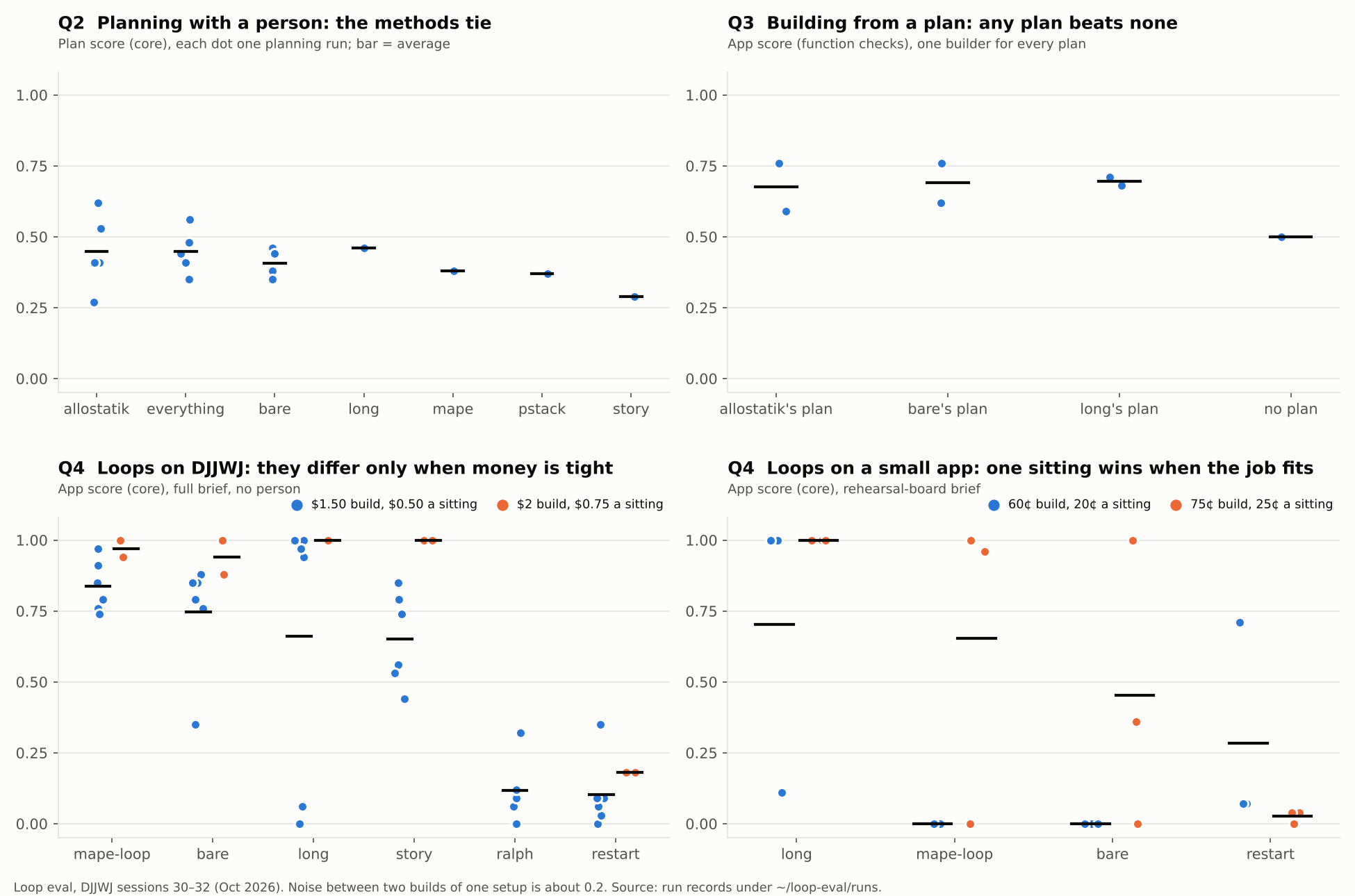
Read it for the spread, not the bars. Within one combination, runs land anywhere from 0.3 to 1.0; between combinations the bars sit inside that spread of each other, except restart and Ralph at the bottom.
Round one, the full brief. Nine combinations, three runs each, every one handed the full brief. The scores bunched at the top of the scale. The reference bare build scored 0.97 on the function checks and 1.00 on the full brief's own checks.
Planning with a stand-in. Five runs each, the plan graded against the brief: Allostatik 0.45, Allostatik with pstack 0.45, no method 0.41. Allostatik's early lead (0.62, 0.53) came from its first two runs and did not repeat on five.
Building from a plan. One builder for every plan, graded on the seventeen function checks: Allostatik's plan 0.76, no method's plan 0.76, one long sitting's plan 0.68. Which method wrote the plan did not show in the app.
The AI does better the better the brief it has, with or without a system
| plan from | plan grade | app: function checks | app: full-brief checks |
|---|---|---|---|
| Allostatik | 0.62 | 0.76 | 0.03 |
| no method | 0.38 | 0.76 | 0.03 |
| one long sitting | 0.46 | 0.68 | 0.35 |
| no plan, short brief only | none | 0.50 | 0.00 |
| the full brief, for comparison | none | 0.97 | 1.00 |
Any plan beat no plan: about 0.69 against 0.50 on the core checks, six builds against one, the plans' scores averaged over two builds each (the table shows the first builds; the second were 0.59, 0.62 and 0.71). The full brief beat every plan. And the full-brief column is the one that moved: only the plan that kept the person's own words produced an app that looked like what was asked for, on one build and one grading pass.
The loops came apart only at a tight budget, and Allostatik was not run at it
Six loops, each given the full brief, no plan and no person, at $1.50 of plan usage per build and $0.50 per sitting, so no loop could finish in one sitting. The table is the first three builds of each; the round then ran to six, which is the eval's own rule for a result. Six-run averages: mape-loop 0.84 (lowest 0.74), bare 0.75, long 0.66 (two zeros), story 0.65, Ralph 0.12 (five runs), restart 0.10. At $2 per build and $0.75 per sitting, every loop but restart scored between 0.88 and 1.00, on two runs each.
| loop | what it is | a | b | c | average | spread |
|---|---|---|---|---|---|---|
| mape-loop | sittings in turn, a written check-plan-do-record loop | 0.77 | 0.85 | 0.79 | 0.80 | 0.08 |
| bare | sittings in turn, no method | 0.79 | 0.88 | 0.35 | 0.68 | 0.53 |
| long | one sitting, the whole budget | 1.00 | 0* | 0.94 | 0.65 | 1.00 |
| story | sittings in turn, the builder's eight-step story loop | 0.44 | 0.56 | 0.74 | 0.58 | 0.29 |
| ralph | Ralph, its own loop | not run | 0.32 | 0.09 | 0.21 | 0.24 |
| ralph-loop | a start from nothing on every call, written | 0.09 | 0 | 0.03 | 0.04 | 0.09 |
* One long build was cut by the budget before its start script was runnable, so the grader could not start it. Ralph's first run failed on a harness fault and was not rerun.
No loop beats plain sittings in turn by more than the noise. The written loop is the steadiest, never below 0.74 over six runs. One long sitting is all or nothing. Restarting from scratch is dead at this budget. On a smaller app, one long sitting won outright, five of six perfect. Given more budget, every loop but restart tied near the top. Allostatik was not in this round, so it has never been run at the budget where the loops came apart.
The code held every change; the unstated want showed only in the runs that asked
Eighteen runs over four sittings, three combinations, on a second, smaller app, with the person's wants changing between sittings while the written brief stayed as it was: a rename at sitting 2, two rulings reversed at sitting 3, and two wants the person held but never stated.
| bare | Allostatik | mape-loop | |
|---|---|---|---|
| reversed ruling kept (notes newest first) | 6/6 | 6/6 | 6/6 |
| reversed ruling kept (director edits any note) | 6/6 | 6/6 | 6/6 |
| rename kept everywhere | 6/6 | 6/6 | 6/6 |
| unstated want: sorted A to Z | 5/6 | 4/6 | 6/6 |
| unstated want: "last practised" | 0/6 | 2/6 | 0/6 |
| runs that asked the person anything | 1/6 | 4/6 | 1/6 |
| questions to the person, in total | 1 | 10 | 1 |
| plan usage per run, average | ~$1.60 | ~$2.90 | ~$1.75 |
Every combination kept every change, because the code remembers what was built. The one difference was in the unstated wants. Allostatik was the only one that asked the person more than once, four runs of six against one each for the others, and the only one that ever built the second unstated want, the one no build added on its own; it appeared only in runs that had asked, at about 1.8 times the cost per run. Two runs is a direction, not a finding, until it repeats.
Toward the next piece
Fidelity, read backward. A judge given a situation from DJJWJ's history, and nothing about its builder, picked the ruling he actually made 87 percent of the time; given his record, 88 percent. The record cannot show its value on rulings a sensible judge would pick anyway. It would show on the rulings where he overruled the AI, and that reading has not been taken.
The builder's own try. He tried all eighteen apps from the moving-target round himself. On what both measure, his scores and the tester's agreed. His own repeat error was larger than any gap between the combinations, so a lone human reading cannot rank them either.
Still open. The blind check of 37 decisions, who-made-it hidden. The overruled rulings. A judge calibrated to his readings, taken many times, with him re-auditing a few. Longer runs rather than more apps, since four short sittings never forced anything to rely on a record.
Outside results
The Scaffold Effect in Coding Agents (2026) found that harness choice changed pass rates by zero to eight points, within or near its noise. CodeAF's public DeepSWE harness data put a plain one-tool baseline second among ten harnesses, within its stated noise of the winner.
The run records are kept beside the eval harness and are not public. Ask.